

What used to take days with agencies and endless back-and-forth now takes one afternoon, if you build the right AI SEO workflow.
Creating a data-driven SEO strategy used to mean weeks of work. Hiring an agency or consultant. Coordinating between keyword researchers, content strategists, and whoever was managing the editorial calendar. Rounds of revisions. Spreadsheets everywhere.
This time, I built our entire 90-day SEO content plan in a few hours using Claude AI and Semrush.
Here's exactly how I did it, step by step, so you can replicate this AI SEO workflow for your own business.
Step 1: Give AI Real Context (Most People Skip This)
The biggest mistake people make when using AI for SEO? They don't give it enough context.
AI isn't magic. It's pattern recognition. If you feed it vague inputs, you'll get generic outputs, the kind of keyword lists and content calendars that could belong to literally anyone.
So before I asked Claude anything about keywords or content pillars, I uploaded our go-to-market (GTM) strategy. Specifically, I gave it:
- Primary target audience (who we're building for, their pain points, their alternatives)
- Competitive landscape (who we're up against, where we overlap, where we differentiate)
- Positioning (how we want to be perceived in the market relative to competitors)
- Product stage (where we are in our lifecycle, what features are live vs. coming soon)
This is the foundation everything else builds on. Without it, AI will fill in the blanks with assumptions, and those assumptions will be wrong.
If you're a small startup, you can start with educated assumptions about your market. Write them down. Be specific. Even a one-page brief is better than nothing.
If you're a larger company, this context needs real research behind it: customer interviews, competitive audits, positioning docs. The quality of your AI output is directly proportional to the quality of your input.
Step 2: Generate the First Draft (And Why You Don't Trust AI Blindly)
With that context loaded, I asked Claude to generate:
- A competitive landscape analysis for our space
- Six content pillars aligned with our positioning and audience needs
- A 90-day content calendar with topic suggestions for each week
- Initial keyword research based on what it understood about our market
And it delivered. Fast.
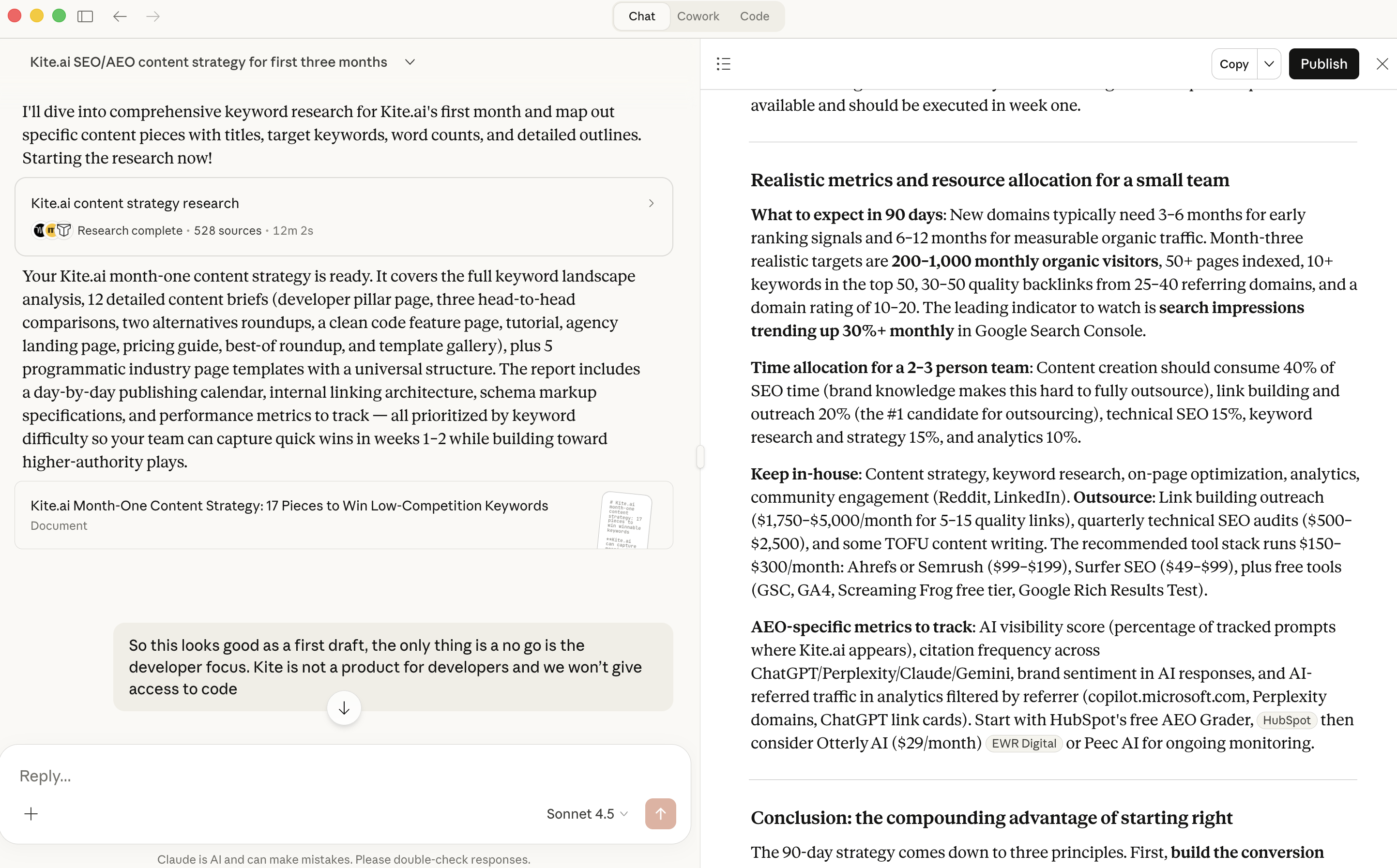
But here's the critical part that separates a useful AI workflow from a dangerous one: Claude made assumptions.
In our case, it assumed a certain relationship between our new product and its parent company, and that assumption shaped the keyword targets, the competitor framing, and the content angles. If I had taken the output at face value, I would have built an entire quarter's content strategy around a flawed premise.
This is why you don't blindly trust AI-generated SEO strategies.
I went through every section. I corrected what didn't make sense. I clarified the nuances that AI couldn't have known. Then I fed the edited version back into Claude so it wouldn't repeat the same mistakes in subsequent outputs.
This feedback loop (generate, review, correct, re-input) is what makes AI useful instead of risky. It's not about getting a perfect first draft. It's about iterating toward accuracy.
Step 3: The Semrush Validation Loop (This Is the Real Power Move)
Here's where the process goes from "interesting AI experiment" to "legitimate SEO strategy."
AI can generate keyword ideas, but it can't tell you real search volumes, keyword difficulty scores, or competitive density. For that, you need actual SEO data. I used Semrush, but this approach works with Ahrefs, Moz, or any keyword research tool that gives you real numbers.
Here's the four-step validation loop I built:
3a: Design the validation framework
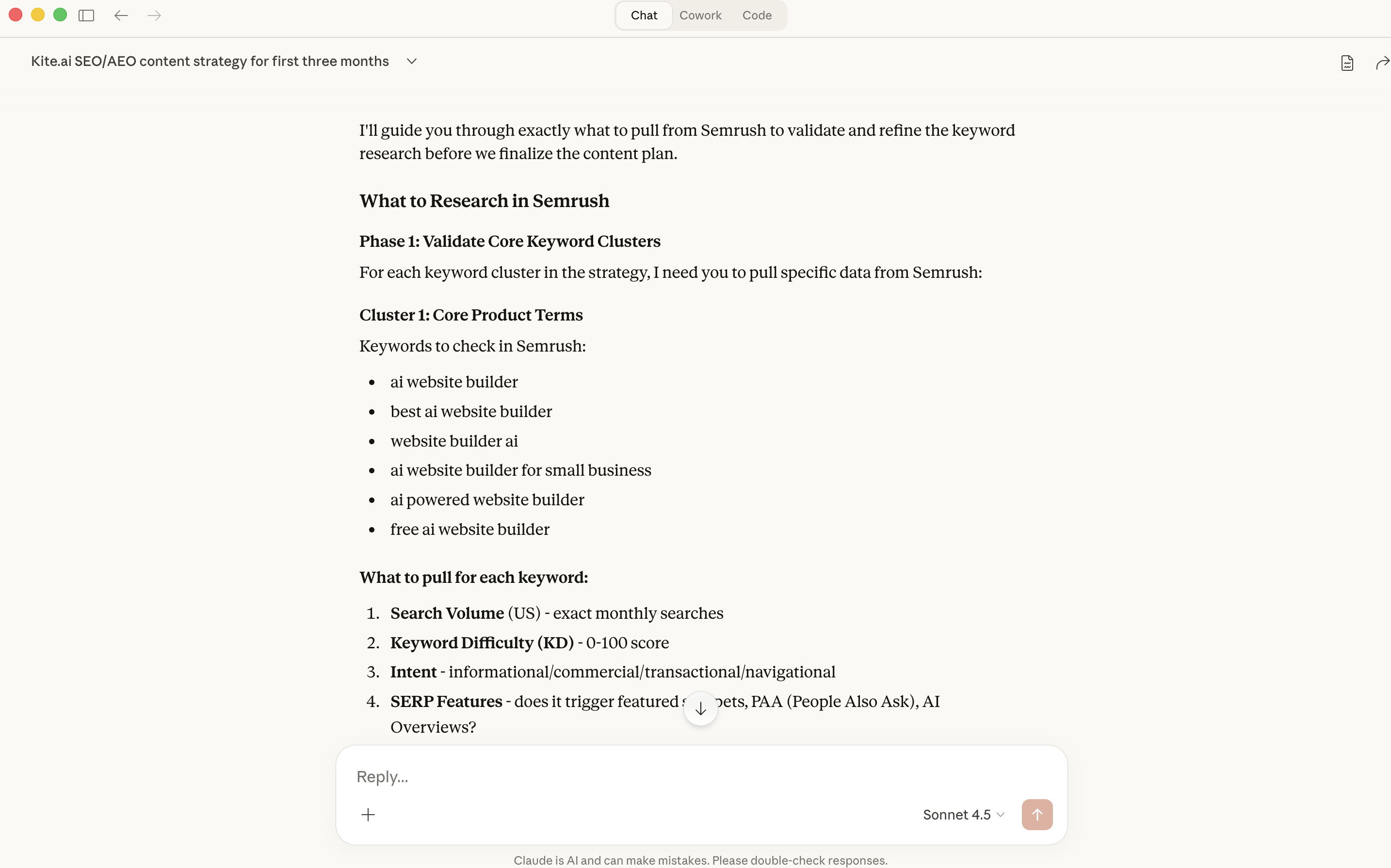
I asked Claude to create a structured framework for validating the initial keyword research. Specifically: what data points to pull from Semrush, how to evaluate them, and what thresholds to use for prioritization.
This gave me a clear research brief before I even opened Semrush, so I wasn't wandering around the tool hoping to find useful data.
3b: Run the research with Claude's Chrome extension
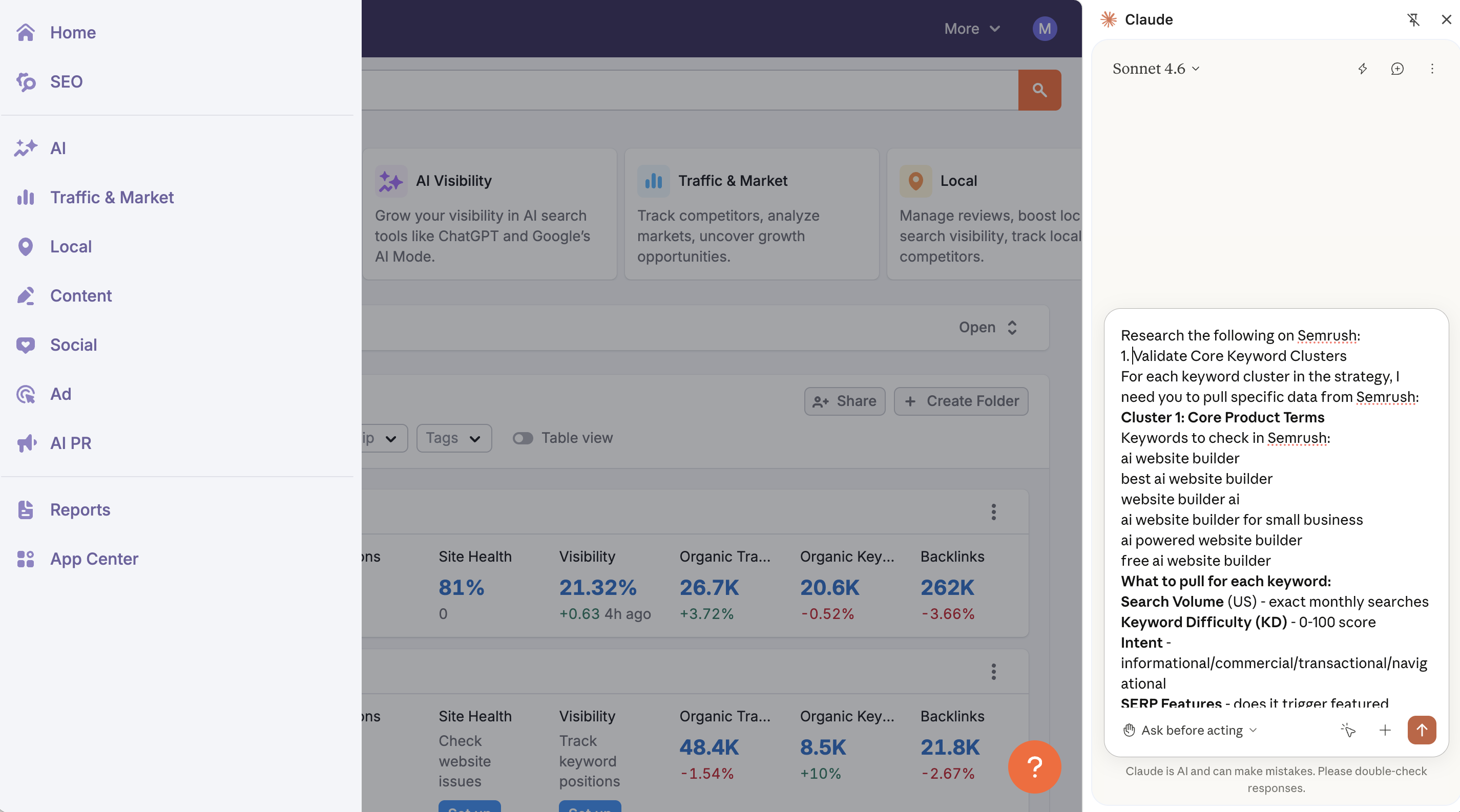
I used the Claude Chrome extension directly inside Semrush to run that research. Instead of manually exporting CSVs and reformatting data, Claude could see what I was seeing in the tool and help me extract the relevant metrics in real time.
This step alone saved hours of manual data pulling and spreadsheet formatting.
3c: Feed the Semrush data back into Claude
With real keyword data in hand (search volumes, difficulty scores, competitive gaps, SERP features), I fed everything back into Claude.
3d: Refine and realign the strategy
Claude took the validated data and realigned the entire content strategy around what the numbers actually showed. Keywords that seemed promising in the first draft turned out to have no search volume. Others that weren't on the initial radar had significant opportunity.
That validation loop replaced what would normally be days of manual SEO analysis.
What I Ended Up With
After roughly an afternoon of focused work, I had:
- Refined keyword clusters organized by topic and intent
- Prioritized opportunities based on real search volume, difficulty, and business relevance
- Search intent alignment (knowing whether each keyword signals informational, navigational, or transactional intent)
- A fully updated 90-day content roadmap backed by actual data
But it went deeper than a typical keyword list. The strategy also included:
- Content format recommendations (which topics should be landing pages vs. blog posts vs. comparison pages)
- Content pillar mapping (which pillar each piece supports and how they interlink)
- Suggested content structure (outlines for how to approach each piece based on what's currently ranking)
- Strategic reasoning (why each topic was prioritized, what competitive gap it fills, and what stage of the funnel it targets)
This is the kind of deliverable that normally costs thousands of dollars from an agency and takes weeks to produce. It took me one afternoon.
The Framework You Can Steal
If you want to replicate this process, here's the workflow in a form you can use right away:
Phase 1: Context loading. Before you prompt anything, prepare a brief that covers your audience, competitors, positioning, and product stage. The more specific, the better. Upload it to Claude (or your AI tool of choice) before you start asking for SEO outputs.
Phase 2: First-pass generation. Ask the AI to generate content pillars, keyword clusters, and a content calendar based on the context you provided. Expect this output to be 70-80% there, good enough to build on, not good enough to execute on.
Phase 3: Human review and correction. Go through every assumption. Challenge the keyword targets. Fix the positioning errors. Feed your corrections back into the AI so it learns from your edits.
Phase 4: Data validation. Take the AI-generated keywords into a proper SEO tool. Pull real search volumes, difficulty scores, and competitive data. Don't skip this step. It's the difference between a strategy based on guesses and one based on evidence.
Phase 5: Final synthesis. Feed the validated data back into AI. Let it reconcile the original strategy with the real numbers. The output should be a complete, data-backed content roadmap you can actually execute.
What This Means for Marketers and Startups
The point of this workflow isn't that AI replaces SEO expertise. It doesn't. You still need to understand your market, evaluate keyword opportunities critically, and make strategic calls that no AI can make for you.
What AI does is compress the timeline. The research that used to take a week now takes an hour. The competitive analysis that required three tools and a spreadsheet now happens in a single conversation. The content calendar that went through five rounds of revisions gets to a solid v1 in one session.
86% of SEO professionals have already integrated AI into their workflows. The ones getting the best results aren't the ones who trust AI blindly. They're the ones who build structured workflows with human oversight at every step.
If you're a startup or a small team without an SEO budget, this approach levels the playing field. You don't need a $10K/month agency to build a real SEO strategy. You need clear context, the right tools, and a process that keeps AI honest with real data.
Start Building Your AI SEO Workflow
You don't need to do everything with AI. And you definitely shouldn't trust it blindly. But if you build the right workflow (context first, AI-generated drafts second, human review third, data validation fourth) it can completely change the speed at which you move.
Ready to build your marketing strategy?
Let's discuss how to create a data-driven approach that moves the needle for your business.
Work with me